With technology evolving at breakneck speed, CIOs, CTOs, and IT leaders are under immense pressure to modernise legacy systems, which are no longer fit for purpose and are holding back business growth. Famous names like IBM AS/400, COBOL-based mainframes, Oracle Forms, Rocket UniData, and Rocket Universe that were once revered as the gold standard are now viewed as legacy platforms – ‘black boxes’ that only a few engineers understand how to work with.
Such limitations are huge and an intolerable risk for a modern enterprise. Organisations spend up to 80% of IT budgets maintaining legacy systems[1] yet 70% of digital transformation projects fail[2], and legacy migration initiatives carry failure rates exceeding 60%[3]. The root cause lies in limited visibility into legacy codebases, fragmented business knowledge, and the absence of a structured, data-driven approach to modernization — turning transformation efforts into costly, high-risk ventures rather than strategic growth enablers.The global legacy modernisation market is projected to reach $24.8 billion by 2027, growing at a 12.3% CAGR[4]. Enterprises are looking for intelligent approaches to guide their legacy modernisation initiatives and spend investment wisely and logically.
With the right strategy and approach, legacy systems can evolve progressively into powerful catalysts for innovation — driving agility, unlocking new possibilities, and delivering continuous value. Drawing on our experience guiding leading organisations on their modernisation journeys, we’ve developed a proven five-stage framework to unlock this value. Our approach provides a clear and actionable roadmap to transform legacy complexity into a strategic advantage, creating a foundation for sustainable digital growth.
Stage 1: Visibility – Seeing Inside the Black Box
Modernisation begins with clarity and understanding. Most legacy systems hide critical business logic within decades-old COBOL, Universe, and RPG code that is often both undocumented and impenetrable. Without visibility, CIOs are left making high-stakes decisions in the dark, risking costly delays, overruns, and compliance failures.
It is imperative that we first extract, catalogue, and map business logic into a unified, searchable knowledge base to bring transparency into legacy environments. CIOs thereby gain a 360-degree view of their legacy ecosystems, revealing dependencies, processes, and data flows in real-time.
Having better visibility allows IT leaders to:
Remove guesswork from transformation and migration initiatives
Empower informed, data-driven decisions at every level
Accelerate modernisation planning
Stage 2: Reliability – Building Stability in Legacy Systems
Legacy systems are the backbone of critical operations — but they can be fragile. IT leaders are often wary of touching legacy complexity “that ain’t yet broke” – leading to haphazard workarounds. However, ageing legacy platforms stitched together over decades can fail without warning. Each outage disrupts business continuity, erodes customer trust, and increases operational risk, causing lasting brand damage.
AI-driven predictive analytics can help bring rigour and discipline to quickly achieve legacy stability. By continuously monitoring legacy environments, predictive analytics can detect anomalies and surface performance risks before they cause disruption. Problems are not just found — they’re prevented.
This helps CIOs achieve tangible outcomes, including:
Significantly fewer outages and incidents through proactive detection
Renewed confidence in the reliability of existing systems
A solid, low-risk foundation for moving forward with cloud migration initiatives eg: Rocket UniData migration to AWS / Snowflake, etc.
Stage 3: Enhancement – Fusing Legacy Realities with Modern Business Needs
Today’s enterprise must integrate faster, comply smarter, and deliver seamless digital experiences. Yet, legacy systems were never built for APIs, analytics, or real-time engagement. Without remediation, a widening gap will exist between technology and business ambition.
By exposing legacy logic through modern APIs and workflow automation, CIOs can extend the life and value of existing legacy environments — enabling innovation without the cost and risk of a full rewrite.
Examples include:
Launching digital customer portals powered by existing core data
Automating compliance and reporting workflows for greater accuracy and speed
Streamlining analytics and insights via seamless integration eg: Rocket Universe-to-Snowflake integration, COBOL to Kafka, AS400 to Salesforce/HubSpot (360° CRM) via iPaaS, etc.
Stage 4: Productivity – Automating Testing and Delivery
Manual QA slows projects and introduces risk from basic human error. In large-scale transformation projects, traditional testing slows progress, inflates costs, and exposes the effort to human bias and testing fallibility.
An automated, intelligence-driven process enables continuous validation across legacy systems — from Rocket UniVerse and UniData to AS/400, COBOL-based mainframes, Oracle Forms, and SAP ECC — ensuring every release is faster, cleaner, and more reliable across the enterprise landscape.
Our experience with intelligent test automation reveals:
35% faster delivery through automated test generation
40% boost in team productivity with streamlined QA workflows
Significant reduction in QA costs without compromising quality
Stage 5: Progressive Modernization – The Safe Path Forward
Full rewrites and “all-at-once” migrations rarely deliver on their promise. They introduce massive risk, spiralling costs, and business disruption — often stalling before real value is realised. Progressive modernization for legacy platforms such as Rocket UniData, Rocket UniVerse, IBM AS/400, COBOL-based mainframes, Oracle Forms, and SAP ECC enables CIOs to modernize incrementally — module by module, mission by mission — without downtime. This pragmatic approach preserves business continuity while accelerating innovation.
Progressive Modernisation Delivers Continuous Business value, through:
Cost-efficient transformation through phased delivery
Seamless cloud adoption across AWS, Snowflake, and hybrid environments
Repeatable, scalable modernisation that evolves with the business
Why Progressive Modernization Wins
Legacy systems no longer need to be bottlenecks. At Mitra AI, we adopt a strategic approach to transform legacy platforms from enigmatic black boxes into a catalyst for dynamic business growth. Through our five-stage model — Visibility, Reliability, Enhancement, Productivity, and Progressive Modernisation — we help IT leaders unlock agility, scalability, and long-term innovation.
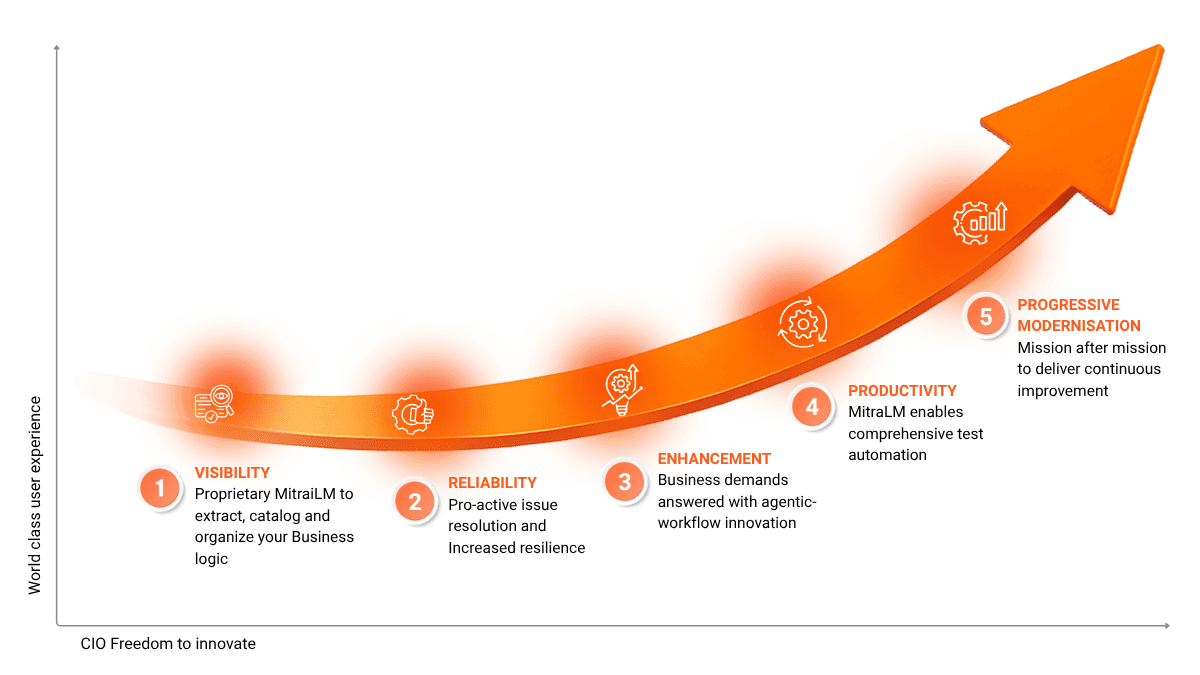
Mitra AI's Proven 5 Stage Legacy Modernization Framework
With RocketDev.AI’s intelligence-driven knowledge extraction, code-to-doc automation, and lineage mapping, and Mitra AI’s orchestration layer powered by generative AI, automation agents, and continuous validation pipelines, organisations can modernise Rocket UniVerse, AS/400, COBOL, Oracle Forms, or SAP ECC environments incrementally and intelligently — ensuring business continuity while accelerating transformation.
Ready to accelerate your Legacy Modernization journey?
Discover how RocketDev.AI™ and MitraILM™ deliver visibility, stability, and continuous progress – whether your goal is migration to AWS, Snowflake, or hybrid cloud.

Thilina Herath
Chief Technical Officer (CTO) at Mitra AI